
Anderson Resident Lookup Records at a Glance
No single official database establishes every fact about a person. An Anderson resident lookup works best when the record chosen fits the question. A parcel record can connect a listed owner to a tax-map number, while a court result supplies a case lead. A vital record can document an event under its access rules. A state credential or entity filing may show a public affiliation, not a present address. Use the record’s own limits as part of the answer.
| Record | What It Confirms | Where | Access |
|---|---|---|---|
| ACPASS property record | Listed parcel owner, mailing address, TMS, and property data where populated | Anderson County Public Access System | Owner search is behind a login or registration gate; current start date is not published |
| Property Viewer | Parcel-linked physical address, TMS, map attributes, and selected record details | Anderson County Property Viewer | Daily updated but nonofficial map data; verify with custodian |
| Trial Court Public Index | Party and case context, names, dates, court, and status lead | South Carolina Judicial Branch and Anderson Clerk | Disclaimer gate, JavaScript and cookies; official files remain at the court |
| DPH vital route | Qualified event, date, county, or certificate lead | South Carolina DPH, Probate, or Clerk by event and date | Date limits and applicant eligibility apply |
| MySCVotes | A voter’s own registration and election-service information | South Carolina Election Commission | Authenticated self lookup, not a public people search |
Start with the identifier already supported by a record. ACPASS accepts an owner name with last name first, a tax map number, or a street name. The Property Viewer can use an E911 address, road, or TMS. A court search can use a party name and case facts. Do not force a name into a tool that is designed for an address or personal authentication.
Anderson Resident Lookup Identity Grid
Before treating any name hit as a match, make an identity grid. Capture the exact name spelling or initials, approximate period, address, TMS or legal description if known, a related person, and an existing case, estate, deed, or other record number. A mailing address may differ from a parcel’s physical or situs address. A case service address or an entity’s registered office may be different again. Each is a record-specific fact, not proof of a current household.
- Use a known address or TMS in the Anderson County Property Viewer to locate the parcel and physical-address context.
- If an owner relationship is relevant, use the account-gated ACPASS property card and note the TMS, owner spelling, physical address, mailing address, and deed reference.
- Compare a second official source, such as a recorded deed’s legal description, a court case number, a vital date, or an estate number.
- Stop when common-name results cannot be separated. A custodian can explain its copy procedure, but should not be asked to make an unsupported identity judgment by phone.
The current public GIS configuration does not verify an owner-name search even though older help describes one. Use login-gated ACPASS for owner-last-name work, and treat the Viewer as the address and map layer rather than title evidence.
Court Fields for an Anderson Resident Lookup
Anderson is in South Carolina’s Tenth Judicial Circuit. The statewide Trial Court Public Index is the primary party and case-index route. Accept its disclaimer, select the appropriate county or court path, and use a surname variant as a lead rather than a final answer. The index is not an assurance of one statewide coverage date, and an online absence does not establish that a person has no court record. The Anderson County Clerk of Court holds the official records for General Sessions, Common Pleas, and Family Court, and its counter is the file, archival-copy, and certified-copy fallback.
| Case Number | Text criterion for a known case. |
|---|---|
| Name | Party or business text; partial matching is supported. |
| Date Type and range | Filed, Disposed, Judgment, or Arrest with From and To dates. |
| Tax Map Number | Property-linked criterion when the case context supports it. |
| Filters | Court Type, Court Agency, Case Type or Subtype, Party Type, and Action Type. |
The documented result grid has Name, Party Type, Case Number, Filed Date, Case Status, Disposition Date, Type, Subtype, Judgment Number, and Court Agency. A case number or party can open details. Where enabled, details can include Actions, Financials, Fines, Fees, Payments, or an image icon. Not every county or case has images. Protected, sealed, juvenile, adoption, and other confidential files are not an open lookup.
The statewide Trial Court Public Index has the disclaimer entry used before a court search.
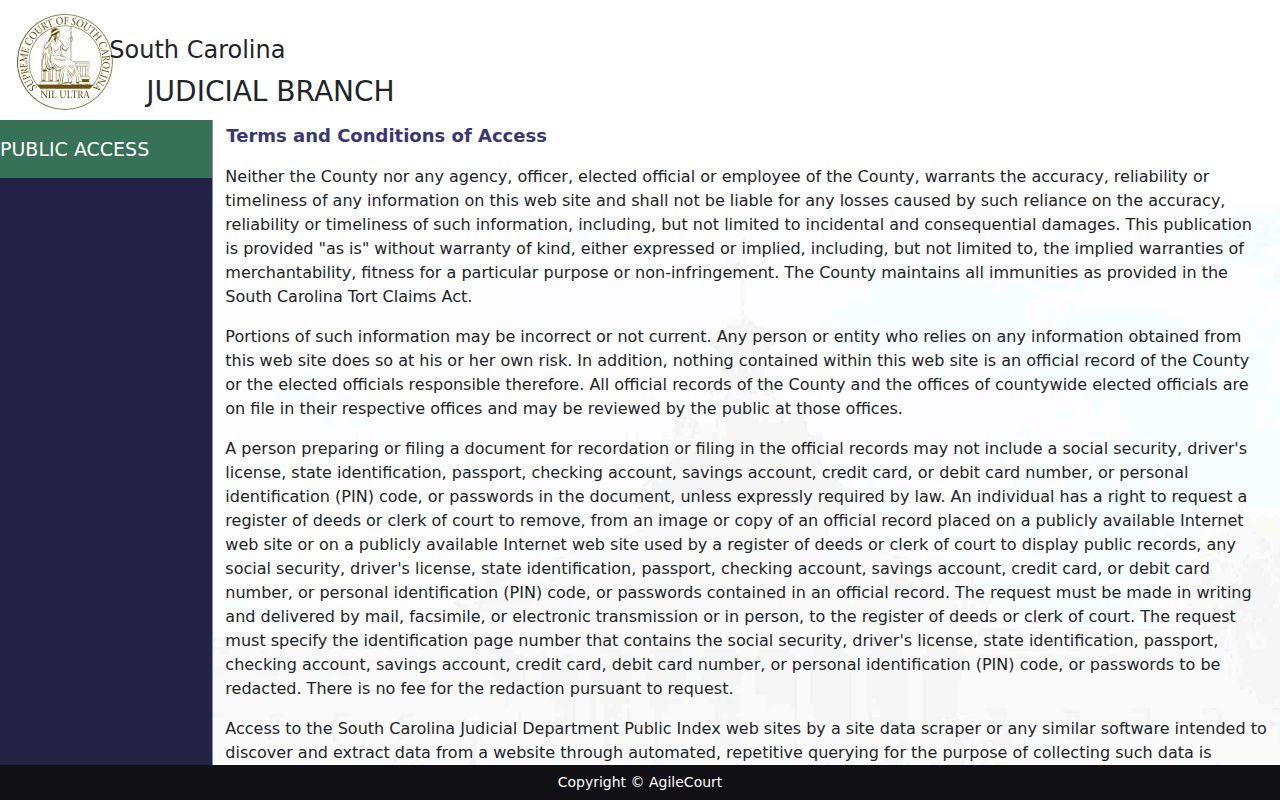
Use a returned case number, court division, party role, and date to request or inspect the official file at the proper Anderson court.
Anderson Resident Lookup and MySCVotes
MySCVotes Check My Voter Registration is an authenticated self-service tool. It asks for County, First Name, Last Name, Date of Birth in mm/dd/yyyy form, the last four digits of SSN, and Login. It can help a voter verify that person’s own registration and election-service information, including related precinct, polling-place, ballot, or participation-service routes. It is not a browse-by-name or browse-by-street directory, and the inspection did not expose required-field labels, a result schema, export controls, or a public coverage date.
The MySCVotes login screen shows the personal matching route for an Anderson resident lookup.
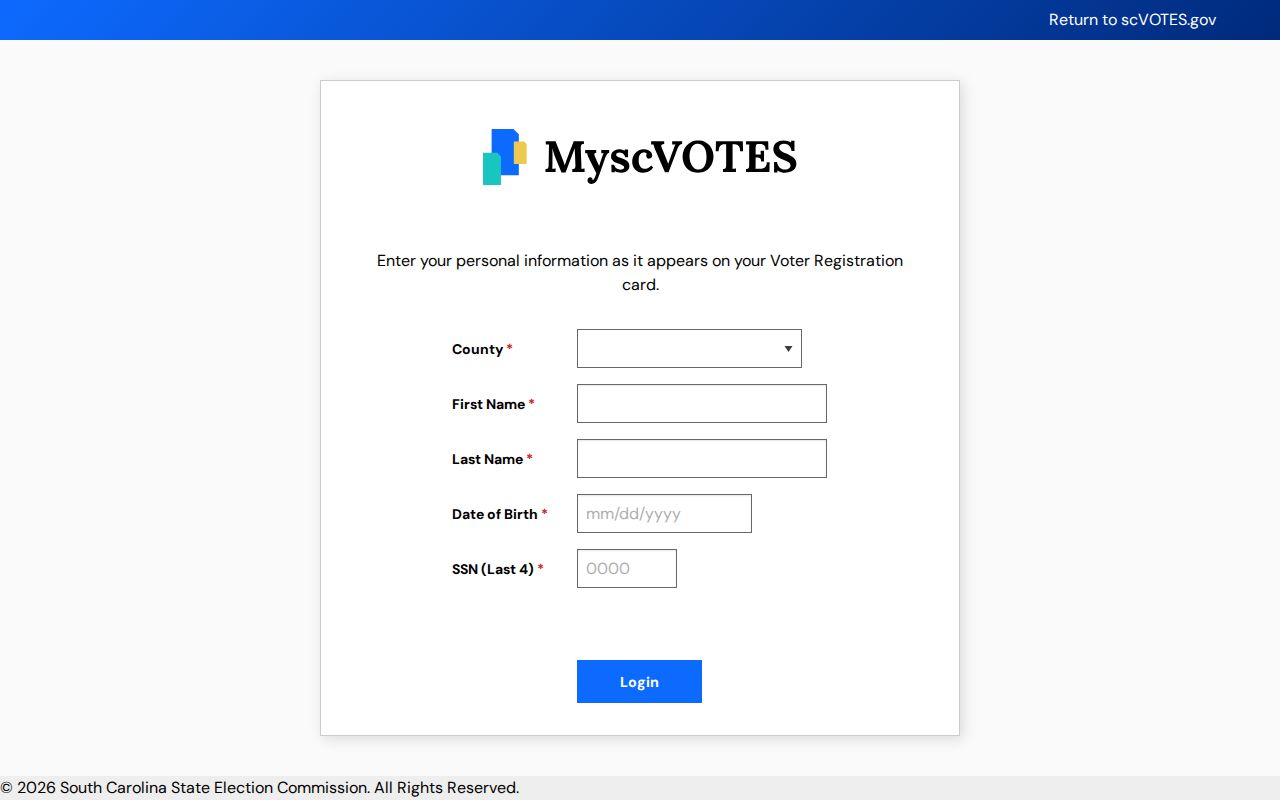
The matching fields are a privacy boundary, not data to publish or use to infer every person at an address.
For a separate public-record question, the Election Commission and county office use election law and South Carolina FOIA procedures. A request should describe a county, period, and lawful field need precisely. The state’s voter-list route is distinct from MySCVotes and has statutory access, format, price, and protected-address limits. Ballot choices remain secret.
Vital Records in an Anderson Resident Lookup
South Carolina DPH is the statewide certificate custodian, but vital records have date and eligibility splits. Birth records become public after 100 years. Death, marriage, and divorce records become public after 50 years under S.C. Code Ann. §§44-63-80, -84, and -86. Public access normally permits an uncertified copy through the stated application route; it does not create a general current name search. Before a record reaches its public period, certifications require an entitled applicant and valid identification.
For Anderson events, DPH’s official death index covers 1915–1967, with a State Archives 1915–1963 route for cross-checking. Its index identifies a deceased person by surname, first name, middle or initial indicator, volume and certificate number, county, date, cause codes, and age. It is an index, not a certified certificate or proof of current residence. DPH issues marriage records for July 1950 through December 2023; earlier or later Anderson licenses belong with Anderson County Probate Court. DPH divorce reports cover July 1962 through December 2023, while an actual Anderson decree is held by the Clerk of Court.
The South Carolina DPH Vital Records page is the official route for forms, service updates, and certificate channels.
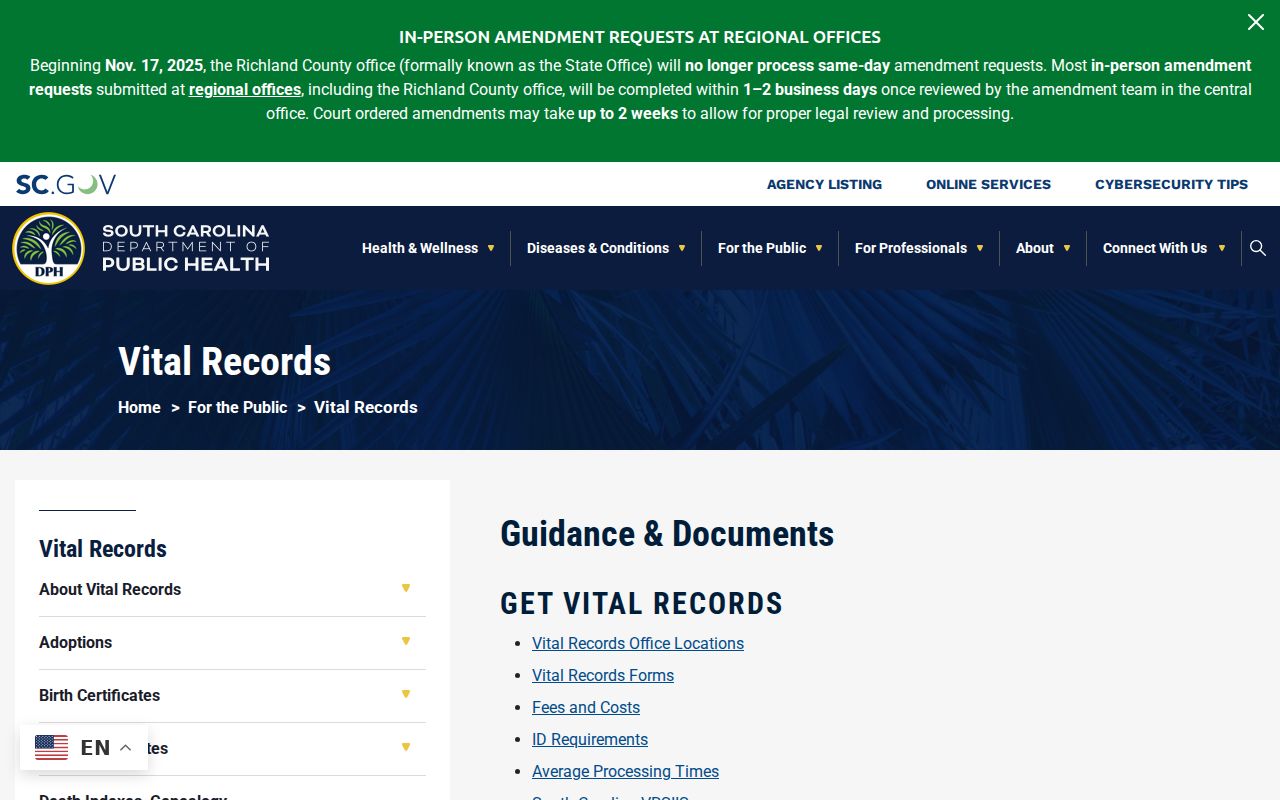
Check the current DPH form and service status before applying, because temporary in-person or drop-off limits can change.
Probate Trails for an Anderson Resident Lookup
Probate Court provides a separate, date-sensitive trail for estates, trusts, guardianship or conservatorship, marriage licenses, and certain settlement matters. When an estate is relevant, compare the decedent, estate number, representative, property link, and date before identifying an heir or beneficiary. Estate files can contain useful relationship and property context, but sensitive material can be sealed or restricted. An estate reference should be confirmed in the actual Probate file before a relationship is stated.
The historical routes are divided. The library holds Anderson Probate Judge estate packets 1–3210 for 1790–1868. Packets 3216–6466, approximately 1876–1915, have a HeritageQuest route with a library card; FamilySearch lists packets and an index through 1–6466. Later records belong with Probate Court. The documented packet numbers and dates leave an acknowledged gap, so it should not be silently filled with an assumption. For a name from a historical directory, use the estate period and property reference to choose the right route.
State business entities and professional credential systems are narrower sources. Business Entities Online searches an entity name and can display public entity or registered-agent information. Board-specific LLR lookups can verify a credential or status. Neither an office, agent, nor credential proves an Anderson residence.
Verifying an Anderson Resident Across Custodians
Use one record to generate a discriminating detail for the next record. A parcel owner plus a matching deed legal description is stronger than a name alone. An estate plus a matching death date and property is stronger than a surname alone. Court names may have variants, and a document image may not be online. When a later claim needs a certified copy, request it from the office that holds the record rather than relying on an index display.
- Anchor the exact spelling to an address, TMS, legal description, case number, or estate number that an official record accepts.
- Use the Trial Court Public Index for relevant name variants, then compare party role, court, case type, and filing or activity date.
- Use a DPH index or certificate channel only for a lawful event-date or county cross-check, observing the date split and applicant rules.
- Request the file, copy, or certification from the Clerk, Probate Court, DPH, Register of Deeds, or other actual custodian when it is needed.
- Docket
- The running court record of activity in a case. It is a case trail, not a statement that every document is publicly viewable.
- Index versus image
- An index points to a record through fields such as name, date, or number. An image is the displayed document itself, which may be unavailable or restricted.
- Certified copy
- A copy issued or authenticated by the record custodian for the uses its rules permit. An online result is not a substitute.
Privacy Endpoints for Anderson Resident Lookup
South Carolina does not provide one universal way to erase truthful public records. Access turns on custody, statutory confidentiality, and targeted remedies. The Attorney General’s Address Confidentiality Program supplies a designated substitute address for qualifying South Carolina participants and must be accepted by state, county, city agencies and courts. It does not delete preexisting material or hide identity. Beginning January 1, 2026, the Judicial and Law Enforcement Personal Privacy Protection Act offers eligible current or former judges and local certified law-enforcement officers a route to seek removal of specified home-address, personal-cell, and tax-map information from public websites.
The Anderson County Register of Deeds also describes a no-fee written procedure to redact defined sensitive numbers from public ROD or Clerk images and copies. It covers items such as Social Security, driver-license or state-ID, passport, payment-card, account, PIN, and password numbers when the request identifies the page. It is not a route to remove names, ordinary property addresses, legal descriptions, or historical facts. Send a correction or redaction request to the custodian with the record number or page instead of relying on a map display.
Lawful use. Use an Anderson resident lookup for personal, civic, family-history, estate, property, or verification questions. South Carolina’s harassment and stalking laws do not permit unwanted contact, surveillance, publication of sensitive facts, or intimidation.
SC FOIA §30-2-50 also restricts knowing use of public records for commercial solicitation. Protected records and missing results are boundaries, not invitations to bypass a custodian or safety program.