
Anderson City Directory Holdings and Access
The Anderson County Library System identifies its Anderson City Directories as a 1905–1960 run. The books sit in the South Carolina Collection. Some titles can be reached remotely in HeritageQuest with a library card, and the library reports that a few editions have University of South Carolina digitizations. That stated run is a collection description, not a promise that every annual issue survives or appears online. Check the exact year, title page, and available format before treating a gap as evidence about a person.
| Collection | Years | Where Held | Access |
|---|---|---|---|
| Anderson City Directories | 1905–1960 | South Carolina Collection, Anderson County Library | Physical books; some HeritageQuest access with library card; a few USC digitizations |
| Digitized publisher editions | 1905–06 through 1920–21 | University of South Carolina digitized collection route | Inspect each edition and its title page |
| Museum city-directory listing | 1905–2006 | Anderson County Museum Roper Research Room | In person Tuesday 1–7 p.m. or by appointment; no remote research |
| Released federal census | 1790–1950 | HeritageQuest, Ancestry Library Edition, and FamilySearch | Library card, in-library, or account route varies by service |
The museum span is a repository listing, separate from the library’s declared 1905–1960 shelf run. Neither statement should be collapsed into a single continuous publication claim.
Anderson City Directory Library Routes
The South Carolina Collection combines directory books with censuses, probate material, deeds, court records, tax books, cemetery records, military rosters, periodicals, and local guides. Its microfilm brochure also identifies Anderson city directories among the locally held collections. The collection is principally for research at Anderson Main Library and does not lend through interlibrary loan. Microfilm readers are available, and black-and-white prints are listed at 10 cents per page. Ancestry Library Edition is an in-library service; HeritageQuest is the stated card-access route for remote research.
For a narrow question, the library accepts a research request for checks of particular indexes. Its paid route allows up to two records to search at $5 per record, plus any postage. The request can be returned as a PDF email attachment, up to 20 scanned pages, or as a mailed copy. The collection asks for a person’s name and any known birth or death date, so a directory year and precise spelling are useful details to give staff. The research address is South Carolina Collection Department, Anderson County Library, 300 N. McDuffie St., Anderson, SC 29621, with research email at research@andersonlibrary.org.
The library’s local-history page shows the collection route used for Anderson city directory research.

Use the library listing to identify the book or database route first, then read the volume itself for its year, publisher, and front matter.
Note: A request is best for a defined index check, not for reconstructing an entire family line from a broad surname.
Anderson City Directory Publishers Online
The University of South Carolina digitized edition range documented for Anderson runs from 1905–06 through 1920–21. It includes Walsh Directory Co. editions for 1905–06 and 1909–10, Piedmont Directory Co. editions from 1911–12 through 1915–16, and Commercial Service Co. editions for 1917–18 and 1920–21. Those are edition-specific observations, not a claim that one company published every Anderson city directory year.
Record the publisher along with the year. A publisher change can mean a different title-page statement, abbreviation legend, arrangement, or coverage practice. The careful record is the exact title printed on the edition being used, rather than a generalized label such as “the Anderson book.” A missing issue online also does not establish that the library lacks it, and a library-held issue does not mean a matching digital copy exists.
| 1905–06 and 1909–10 | Walsh Directory Co. editions documented in the USC set. |
|---|---|
| 1911–12 through 1915–16 | Piedmont Directory Co. editions documented in the USC set. |
| 1917–18 and 1920–21 | Commercial Service Co. editions documented in the USC set. |
| Library run | Anderson City Directories, 1905–1960, stated by the South Carolina Collection. |
Reading an Anderson City Directory Entry
There is no verified rule for every Anderson city directory entry. The library source did not publish a local scanned sample or a universal abbreviation key. At the shelf or in a digitized image, inspect the exact edition’s front matter before assigning meaning to a mark. Copy the printed surname, given name or initials, spouse notation, street and number, work notation, any owner or rental mark, the year, publisher, and nearby same-surname entries. That preserves the evidence needed to revisit a reading later.
| Exact printed name | Capture spelling, initials, punctuation, and spouse notation without expanding them. |
|---|---|
| Street and number | Copy as printed, then compare the same address in nearby editions or maps. |
| Work notation | Transcribe it only when the edition shows it; do not supply a missing detail. |
| Edition evidence | Keep the year, publisher, title page, and abbreviation legend with the transcription. |
- Criss-cross directory
- An address-arranged directory that can run from street and number back to a listing. No separate Anderson reverse run was verified, so ask collection staff or check the catalog first.
- Householder index
- An index arranged around household names. Its presence and scope must be checked in the individual volume.
- Abbreviation key
- The legend printed by a particular edition, usually in its preliminary pages. Photograph or transcribe it before interpreting shorthand.
Anderson City Directory Archival Context
The digitized 1915–16 Anderson edition contains a publisher’s asterisk convention that explicitly racially classifies people. It is a historical feature of that particular publication, not a present-day category and not a safe shorthand to carry into a modern description. When the notation matters to a research question, consult the original legend and preserve the context respectfully rather than recasting the publisher’s rubric.
That same 1915–16 edition supplies documented abbreviation evidence: h for house or residence, bds for boards, wid for widow, emp, elk, tchr, wks, (r) for rear, and rms for rooms. Its sample entries combine surname or initials, a spouse in parentheses, work information, and a house address. Treat those details as evidence for 1915–16 only. Another title or publisher may use a different key or omit a field.
Anderson City Directory Collection Timeline
Anderson’s record history helps keep directory dates in their correct setting. Anderson County formed from Pendleton District in 1826, and the City was incorporated in 1833. A directory search is much later than those milestones, but older family and property research can shift to Pendleton material rather than disappearing from the record trail. The dates below describe documented collection and publisher points, not a complete publication calendar.
- 1905–06: Walsh Directory Co. appears in the documented digitized edition set.
- 1905–1960: Anderson County Library states this city-directory run in its South Carolina Collection.
- 1911–12 to 1915–16: Piedmont Directory Co. editions are identified in the digitized set.
- 1917–18 and 1920–21: Commercial Service Co. editions are identified in the digitized set.
- 1905–2006: Anderson County Museum’s repository listing reports city-directory holdings for this separate span.
The dates clarify why a search should identify the custodian and edition rather than treat “Anderson directory” as one uniform source.
Tracing an Anderson City Directory Household
Use a city directory as a dated lead, then test it against other custodial records. Start with a known surname, address, or likely year. Transcribe rather than paraphrase the entry. A change between editions can signal a move, a changed listing practice, or a different person with a similar name. The released federal census provides household, age, birthplace, relationship, and geographic context, but it does not replace annual city-directory evidence and is public only through 1950 as of the research date.
- Locate the closest available Anderson directory year and copy the entry, title-page year, publisher, and abbreviation key.
- Check the preceding and following available editions for the same spelling, initials, and street number.
- Pair that interval with the nearest released federal census through HeritageQuest, Ancestry Library Edition, or FamilySearch.
- For a property connection, use the legal description and historic conveyance route by grantor and grantee, not just a street number.
- For a death or estate lead, compare the official DPH index or certificate route with the appropriate Probate packet or estate file.
A disappearance from an Anderson city directory is not a conclusion. It may reflect a move, death, a changed name form, a gap in access, or a choice by the publisher. An obituary or newspaper notice can add a date or relationship lead, but it needs corroboration from the custodian record.
Anderson City Directory Museum Listing
The Anderson County Museum Roper Research Room is a second local repository, with books, manuscripts, photographs, maps, city directories, and family genealogies. It reports roughly 2,800 library holdings and about 22,000 cataloged artifacts, some searchable through PastPerfect. The room is at 202 E. Greenville Street and is open Tuesday from 1 to 7 p.m. and by appointment. Volunteers assist visitors, but the museum does not offer remote research; a nonlocal researcher must use a local researcher and follow reproduction or publication rules.
The Roper Research Room source documents this separate Anderson city directory repository.
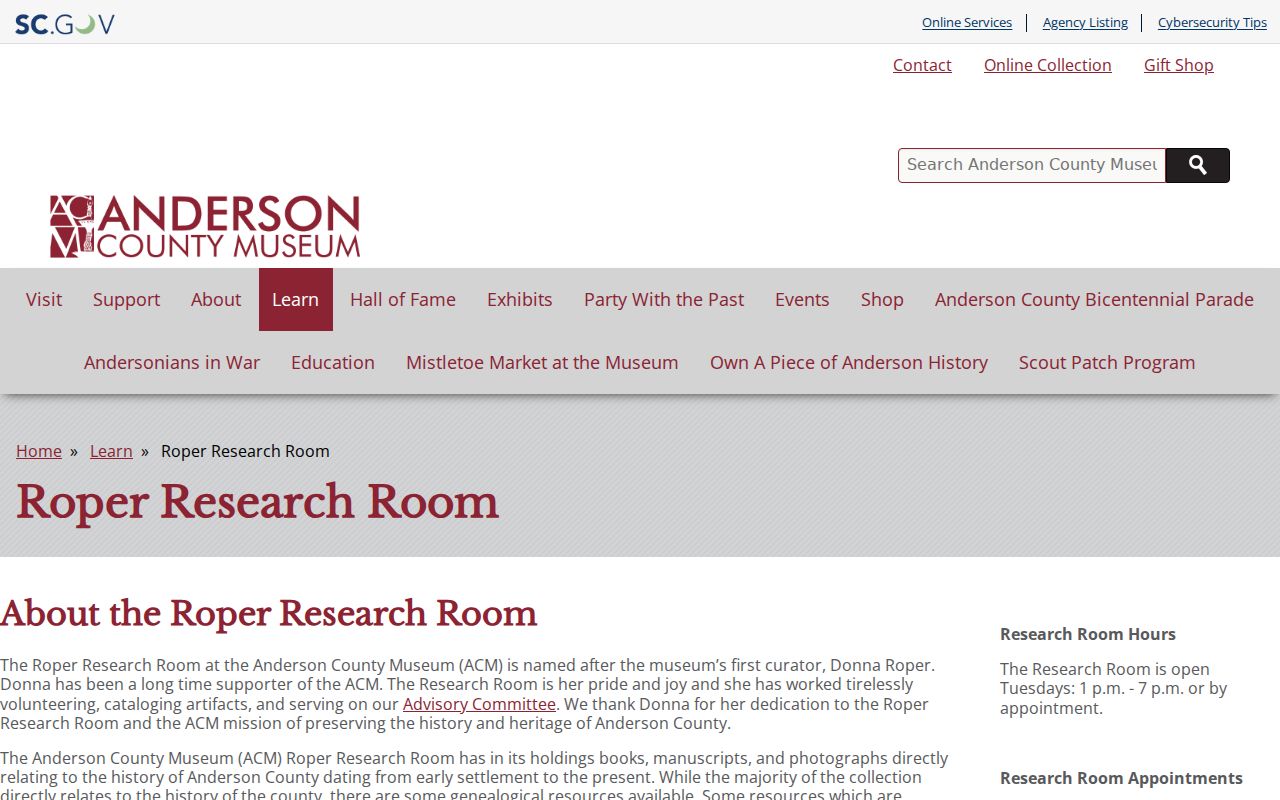
The museum’s 1905–2006 directory listing is useful as a repository lead, while the library’s 1905–1960 statement remains the declared collection run.
Anderson City Directory Companion Sources
Several local sources can test a directory lead without pretending to be another city directory. The library’s obituary index covers local-paper indexing for 1950–55, 1971, 1980, and 2010–18, with a listed $5 copy charge and up to five per request. Later Independent-Mail coverage is available through card-access ProQuest. The direct obituary database was inaccessible during research, so its current fields and output should not be assumed.
Library-held T.L. Hanna and Anderson High yearbooks follow a documented 1924–2014 pattern. Anderson College or University yearbooks have a noted digitized 1942–1998 run. First Creek Baptist minutes, federal citizenship admissions, Faith Clayton Genealogy Room material, newspapers, census, and probate packets can also add a date or kinship lead. Their use is targeted: none creates a present resident roster, and no unverified reverse-directory series should be claimed for an address search.
Note: Keep the precise newspaper title, publication date, and page with any notice because library coverage descriptions include a minor Anderson Gazette date discrepancy.