
Start an Anderson Residents Search
An Anderson residents directory is a set of record trails, not a single public list. Begin by naming the question. A current parcel-owner question belongs with the County Property Viewer and ACPASS. A past household question belongs with the 1905–1960 city-directory books and released census records. An estate question belongs with Probate Court or the library’s dated packet series. A voter who is checking personal registration should use the authenticated MySCVotes service. Recording the right key early matters: a tax-map number, deed reference, legal description, court case number, estate number, directory year, or census enumeration distinguishes people with the same name far better than a loose search result.
Each Anderson record has a narrow meaning. A map can locate a parcel. A deed can document an instrument’s parties and property description. A historic directory can place a printed name at an address in one edition. None automatically proves every person now living there. Current household, utility, driver, and protected-address information is not an open residents directory. When a lead conflicts, compare it with the custodian’s record instead of collecting unrelated name matches.
- Match the question to its time period and record keeper before entering a name or address.
- Use an E911 address in the Property Viewer to collect the parcel’s TMS and physical-address context.
- Compare the property lead with the cited deed, court number, or Probate file when the claim needs confirmation.
- For an earlier household, transcribe the exact spelling and year from the South Carolina Collection, then compare nearby directory and census years.
- Use the office counter, library research request, Archives route, or a focused South Carolina FOIA request when the online route does not cover the needed record.
Anderson Resident Records Custodians
Anderson is the Anderson County seat, so several central custodians are close together but keep different files. The Register of Deeds records and indexes property instruments. The Assessor and GIS/E911 functions connect an address to tax-map and parcel context. The Clerk of Court keeps General Sessions, Common Pleas, and Family Court records, while Probate Court handles estates and Anderson marriage licenses. The county election office and State Election Commission administer voter records under separate rules. Street-level work belongs in the Anderson street directory; these office roles help choose the first counter or portal.
Anderson County Register of Deeds
401 E. River Street
Anderson, SC 29624
864-260-4054
Anderson County Assessor
Anderson County administration
Anderson, SC
864-260-4028
Anderson County Voter Registration
301 N. Main Street
Anderson, SC 29621
864-260-4035
Anderson Parcel Clues Before Deeds
The open Anderson County Property Viewer is the practical start for a known address. Its help describes Road and Address searches, an E911-address step, parcel selection, a Details panel, and map navigation. A selected parcel can supply the geographic bridge to later research. County materials describe fields such as TMS, physical address, deed reference, sale information, tax district, current plat, and a property-record-card link when populated. Treat the viewer as a locator. It says its data are updated daily and are not the official county record.
The key distinction is physical address versus owner mailing address. A tax-roll mailing address may direct notices somewhere other than the property. A legal description, TMS, plat, and recorded deed tie the land trail together more reliably than a street number alone. For the current record card, ACPASS provides Real Property search modes, but its public entry currently directs visitors through a registration/login gate. The street directory has the full address-to-deed method.
See the Property Viewer entry screen before starting an address-based Anderson residents directory search.
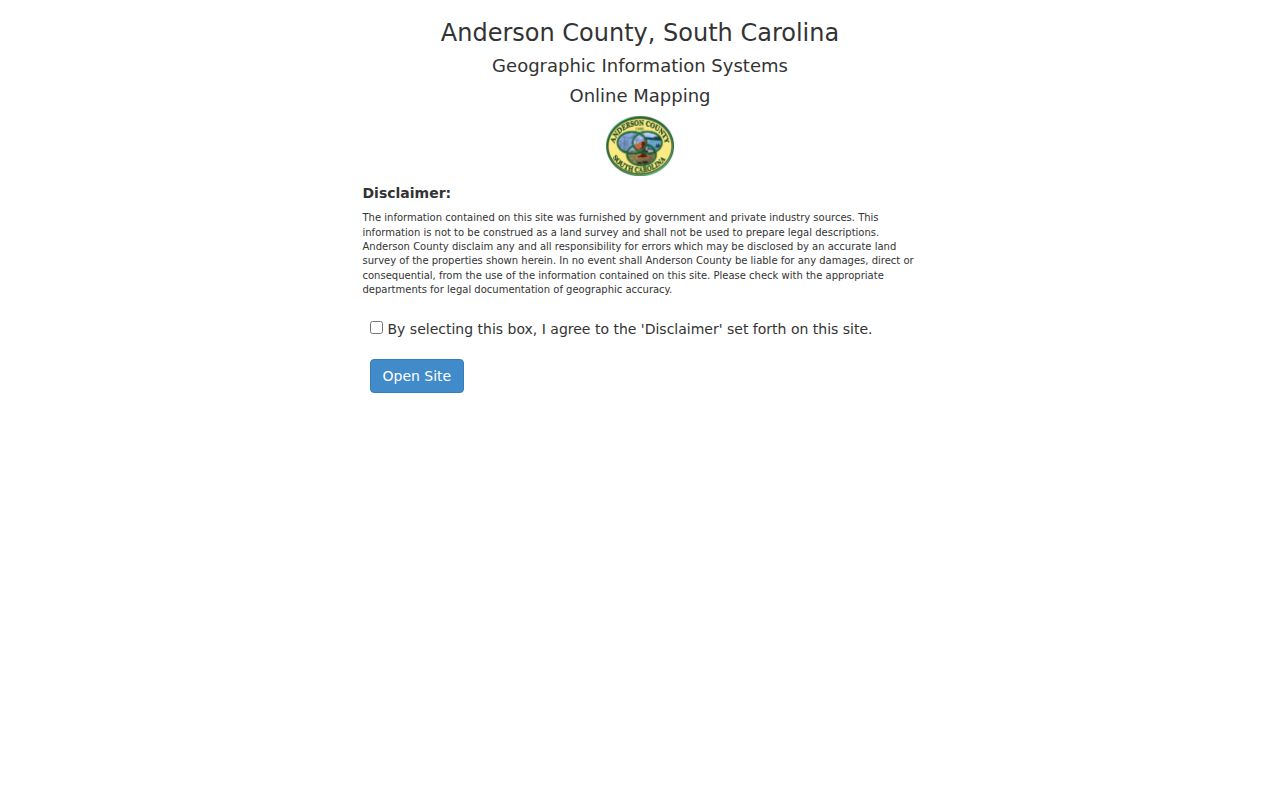
The map is useful for selecting one parcel and recording its identifiers before a custodian confirms title or a household claim.
Anderson Property Search Fields
ACPASS and the Property Viewer accept different keys. County instructions for ACPASS specify Real Property, then Property Search, with Owner Name entered last name first, Taxmap, or Street Name. The instructions do not publish its post-login filter list, result fields, export controls, or coverage start date. The Viewer’s published help is more specific about its open tools. An address search first checks E911 addresses and then the parcel beneath the selected point. Advanced Search documents Market Value as a numeric field without characters, while Bookmark Search includes Tax Map Grid and Subdivision.
| Anderson tool | Documented field | Format or behavior | Access limit |
|---|---|---|---|
| ACPASS | Owner Name | Last name first | Login/registration observed |
| ACPASS | Taxmap or Street Name | County instructions confirm both modes | Post-login schema not published |
| Property Viewer | Address | E911 address then parcel selection | Map is nonofficial |
| Property Viewer | Road, Market Value, Subdivision | Market Value is numeric; subdivision autocomplete begins after three letters | Full advanced-field list not published |
Note: New deed or plat changes can reach the map and tax record in the following tax year, so a recent instrument may need a direct office check.
MySCVotes and Anderson Voters
MySCVotes is a personal verification service, not an Anderson residents directory by street. Its visible screen asks for County, first name, last name, date of birth, and the last four digits of a Social Security number before login. It can help a voter verify personal registration and election services. It should not be treated as an anonymous name or address browser.
South Carolina has a separate, statute-governed voter-list route. The Election Commission describes saleable data for qualifying registered voters and says outputs and fields vary with the permitted order. The route has restrictions, protected-address provisions, and no connection to a person’s ballot choices. Ask the election custodian what form and field set is currently lawful for the stated purpose. An absent voter result does not establish that someone does not live at an Anderson address.
Current Anderson Resident Records
Current Anderson sources are best used as narrow directories of a record relationship. Property tools identify parcels and owners where populated. A deed index identifies instrument parties. The court index identifies a case lead. Probate records can identify an estate connection. A personal voter login confirms the voter’s own record. Each source supports a different answer, and the keeper remains the place to resolve an unclear result.
| Source | Who It Lists | Keeper | Access |
|---|---|---|---|
| Property Viewer and ACPASS | Parcel owners and property context | County GIS/Assessor | Open map; ACPASS account gate |
| Recorded-property instruments | Grantors, grantees, and legal-property trail | Register of Deeds | Office and land-record routes |
| Trial Court Public Index | Case-party and docket lead | SC Judicial Branch | Acceptance gate, then Clerk confirmation |
| Probate estate records | Estate and representative context | Anderson Probate Court | Counter; dated library packets for older series |
| MySCVotes | A voter’s own registration information | SC Election Commission | Authenticated self-service |
A name that appears in one category is a lead, not an identity decision. The Anderson resident lookup route shows how to compare a name, time period, property key, and case or estate number before relying on a match.
Anderson Court Leads and Clerks
The statewide South Carolina Trial Court Public Index provides a case lead after its disclaimer gate. Its official guide documents Case Number, party or business Name, Action Type, Date Type and range, and Tax Map Number. Court Type, Court Agency, case type and party role can further narrow a search. The result grid can identify name, party type, case number, filed date, case status, disposition date, type, subtype, judgment number, and court agency. Images are not available for every case.
For Anderson, the Clerk of Court is the custodian for General Sessions, Common Pleas, and Family Court files at the courthouse. Municipal Court is a separate City channel, although its records are included in the statewide trial-court system. A docket hit is only a starting point. Compare the party role, court, date, and case number, then request a copy or certified record from the relevant court. Sealed, juvenile, adoption, and other protected matters are not open resident-search records.
Anderson’s 1905 to 1960 Shelf
The South Carolina Collection at Anderson County Library identifies Anderson City Directories for 1905–1960. The books are held in the local collection. Some are available remotely through HeritageQuest with a library card, and the library notes that a few were digitized by the University of South Carolina. That range does not promise a surviving or digital volume for every year. The exact book, title page, and any abbreviation key should be checked before taking an entry as fact.
Historical research has a wider Anderson route than the current portal alone. The collection identifies conveyance indexes from 1790–1948, deed books from 1789–1901, estate packets, tax books, maps, and newspapers. A bounded library research request can check up to two record types at $5 per record search, plus listed reproduction and postage charges. The direct physical, remote-card, paid-request, and Archives or FamilySearch channels are useful fallbacks when an online account does not reach the needed era.
Visit the Anderson Library local-history collection for the source list and research-request rules.

The library route helps place one family or address in a dated historical source without making the collection sound like a current household list.
SC FOIA for Anderson Records
When the correct Anderson record is not online, the South Carolina Freedom of Information Act provides a structured request path rather than an invitation to guess. Under S.C. Code Ann. §30-4-30, a public body generally decides a written request within 10 business days, or 20 business days for a record more than 24 months old. After granting access, it generally produces records within 30 calendar days, or 35 calendar days for older records. Exemptions still apply, and a custodian can request a deposit of up to 25 percent of anticipated copying cost.
The County form asks for name, address, phone, email, department, and a specific request. It also has a print/fill/fax/mail alternative. Narrowing the record type, location, date range, and case, parcel, or document reference makes the request more useful to the custodian. Inspection to decide whether a record is disclosable cannot carry a fee. The County FOIA form also warns that public records cannot knowingly be obtained or used for commercial solicitation directed to someone in the state.
Protected Anderson Address Gaps
Missing information is sometimes intentional. South Carolina’s Address Confidentiality Program provides a substitute government address for qualifying participants and requires state, county, city agencies and courts to accept it. The program does not erase older public material, but it can explain why an expected current address is absent or different. From January 1, 2026, eligible judges and certain law-enforcement officers may seek removal of a home address, personal cell number, and tax-map number from public websites under the Judicial and Law Enforcement Personal Privacy Protection Act.
The Register of Deeds also publishes a no-fee written procedure to remove listed sensitive numbers, such as Social Security, driver-license, passport, and financial-account numbers, from publicly displayed images or copies. That remedy does not remove ordinary names, property addresses, or legal descriptions. Vital records, court files, election information, and map results have their own limits. A responsible Anderson residents directory search stops at those boundaries.
Anderson Permit Lists Date Change
County Building and Codes publishes monthly permit PDFs that add a dated address layer. A 2026 list documents fields including permit number, record type, date issued, proposed use, contractor, total construction valuation, project address, and project tax-map number. That pairing of address and TMS can help date construction or alteration at a parcel. It does not identify a resident, and a contractor or applicant should not be treated as an occupant or owner.
Inside the City, Building and Codes directs users to ViewPoint Cloud for permits, inspections, plan review, and ordinance workflow. The direct portal was not accessible during research, so its searchable fields and public result scope are not confirmed. The City counter is the reliable fallback. Recent City OpenGov permitting and licensing work followed Master Address Table and unique-ID synchronization, a reminder that a portal interface can change while the custodian and a focused request remain the stable route.
Anderson Historical Directory Trail
Anderson’s historical directory trail changes keeper and form by era. The library declares a 1905–1960 city-directory run, while a State repository listing for the Museum’s Roper Research Room describes city-directory holdings from 1905–2006. University of South Carolina digitized editions cover selected 1905–06 through 1920–21 years and document publisher changes across Walsh, Piedmont, and Commercial Service editions. Keep the collection statements separate, and record the exact edition and publisher used.
A directory entry can provide a dated name and address clue, but it should be transcribed exactly and compared to nearby editions, released census records, deeds, or Probate material. The library confirms historic city directories but does not confirm a separate Anderson reverse or criss-cross run. Ask collection staff or search the catalog before claiming that an address can be read backward. The full collection method is on the Anderson city directory page.
- Roll
- A list tied to one administrative purpose, such as property, court, or registration records.
- Index
- A finding tool pointing to a record, not always the full image or certified copy.
- Parcel
- A defined tract of land represented by a tax-map number and legal description.
- Criss-cross directory
- An address-to-name directory format; a separate Anderson run is not confirmed in the research.